The short answer
Mexico is the most common destination for Americans buying property abroad, and roughly 797,000 U.S.-born people live there. There is a great deal to recommend it: proximity, established communities, and holding costs a fraction of those at home. What is surprising is that the person showing a foreign buyer the property is not in a position to act on that buyer's behalf — and this has nothing to do with character.
Three structural facts explain it. In most of the country, no licence is required to sell real estate. The agent's fee comes from the seller and is calculated as a percentage of the price, so a lower price means a smaller fee. And one agent handling both sides of the same sale — prohibited in eight U.S. states and, since 2018, in British Columbia — is lawful and unremarkable here.
The notario público, the state-appointed lawyer who makes the transfer legally valid, is required to remain neutral between the parties. That neutrality is the office, not a shortcoming of it.
So a buyer arriving from a market where representation is assumed should establish, early and in writing, who in the transaction is answerable to them alone.
There is no licence to lose
In the United States and Canada, selling real estate requires a licence issued by the state or province. Obtaining one involves prescribed coursework and an examination; keeping it generally requires continuing education; and the regulator that issues it can suspend or revoke it. Whatever its imperfections, the arrangement means someone can be removed from the profession.
Mexico has no federal licensing regime for real estate agents. There is no national exam and no national register. A handful of states — Sonora among the clearest examples — have legislated their own registration requirements, and others have moved in that direction, but across most of the country no legal qualification stands between a person and the business of selling property.
The person showing you a $400,000 property may hold a professional qualification, years of training and a serious reputation. They may equally have started last month. In most of Mexico the law does not distinguish between the two, and a business card will not either.
Voluntary structures do exist. AMPI — the Asociación Mexicana de Profesionales Inmobiliarios, founded in 1956 — is the national professional association, publishes ethical standards and runs a certification programme. A separate competency standard is available through CONOCER, the government body that certifies occupational competence under the education ministry.
Both are elective. AMPI can expel a member; it cannot prevent that person selling property the following week. That AMPI has spent years campaigning for a statutory licensing framework is itself a reasonable indication that none exists.
Who pays the agent, and what that buys
Commissions in Mexico commonly run 5% to 8% of the sale price, reaching around 10% in premium markets and exclusive arrangements. The seller pays, at closing.
Value-added tax is added to that fee at 16%. The sale of a residential property is itself exempt from IVA under Article 9 of the value-added tax law, so the tax falls on the commission rather than on the price. On a $400,000 home at 6%, the commission is $24,000 and the IVA on it is roughly $3,840 — a figure the seller accounts for, and one worth understanding when you are told what the transaction costs.
Most Mexican agencies work under an exclusive right-to-sell agreement. The seller signs with one agency, which earns the commission when the property sells regardless of who introduces the buyer. Where a second agency brings the buyer, the two firms typically divide the fee. Where the listing agent finds the buyer themselves — or the buyer simply arrives unaccompanied — that agent keeps the whole commission instead of half of it.
An agent who ends up on both sides of the same sale is not breaking any rule. They are retaining a fee they would otherwise have shared.
Percentage commission creates the same pull in every market: a higher price produces a larger fee. In a two-agent sale that pull is at least opposed, because the buyer's agent is paid to push the other way. Where one agent holds both sides there is nothing on the other end of the rope.
The asymmetry is worth seeing in figures.
$20,000
What a 5% price reduction is worth
to the buyer
$1,200
What the same reduction costs
an agent on 6% commission
On a $400,000 property. Illustrative arithmetic.
The interests are not merely opposed; they are opposed on wildly different scales, and the party with almost nothing at stake is the one conducting the conversation.
One agent, both sides
North American regulators treat this arrangement as a conflict serious enough to legislate against.
Eight U.S. states prohibit dual agency: Alaska, Colorado, Florida, Kansas, Maryland, Texas, Vermont and Wyoming. In British Columbia it has been prohibited since 2018, when the province became the first in Canada to do so, with a narrow exemption for remote areas where separate representation is impracticable and penalties reaching $250,000 for an individual licensee.
What those jurisdictions put in place instead is the more revealing detail. Colorado and Florida use a transaction broker model, Texas an intermediary model, Alaska and Wyoming designated representatives. Each permits one agent to handle both sides only on the condition that the agent stops advocating for either of them. Regulators concluded that the conflict cannot be managed while the duty to advocate remains, so they removed the duty.
Where the practice remains lawful in North America it generally requires written informed consent from both sides. The Consumer Federation of America estimates that between one in ten and one in five U.S. home sales involve a single agent on both sides.
In Mexico the arrangement is lawful and carries no comparable framework — no neutral-broker status to fall into, no prescribed consent form setting out what the buyer forgoes, and no regulator to raise it with afterwards.
The notario is neutral by design
In the United States and Canada a notary chiefly witnesses signatures. A Mexican notario público is a senior lawyer who has passed a demanding examination and holds a restricted public appointment from the state governor, carrying personal civil and criminal liability for the instruments they authorise. No property transfer is valid in Mexico unless a notario formalises it and it is entered in the Public Registry.
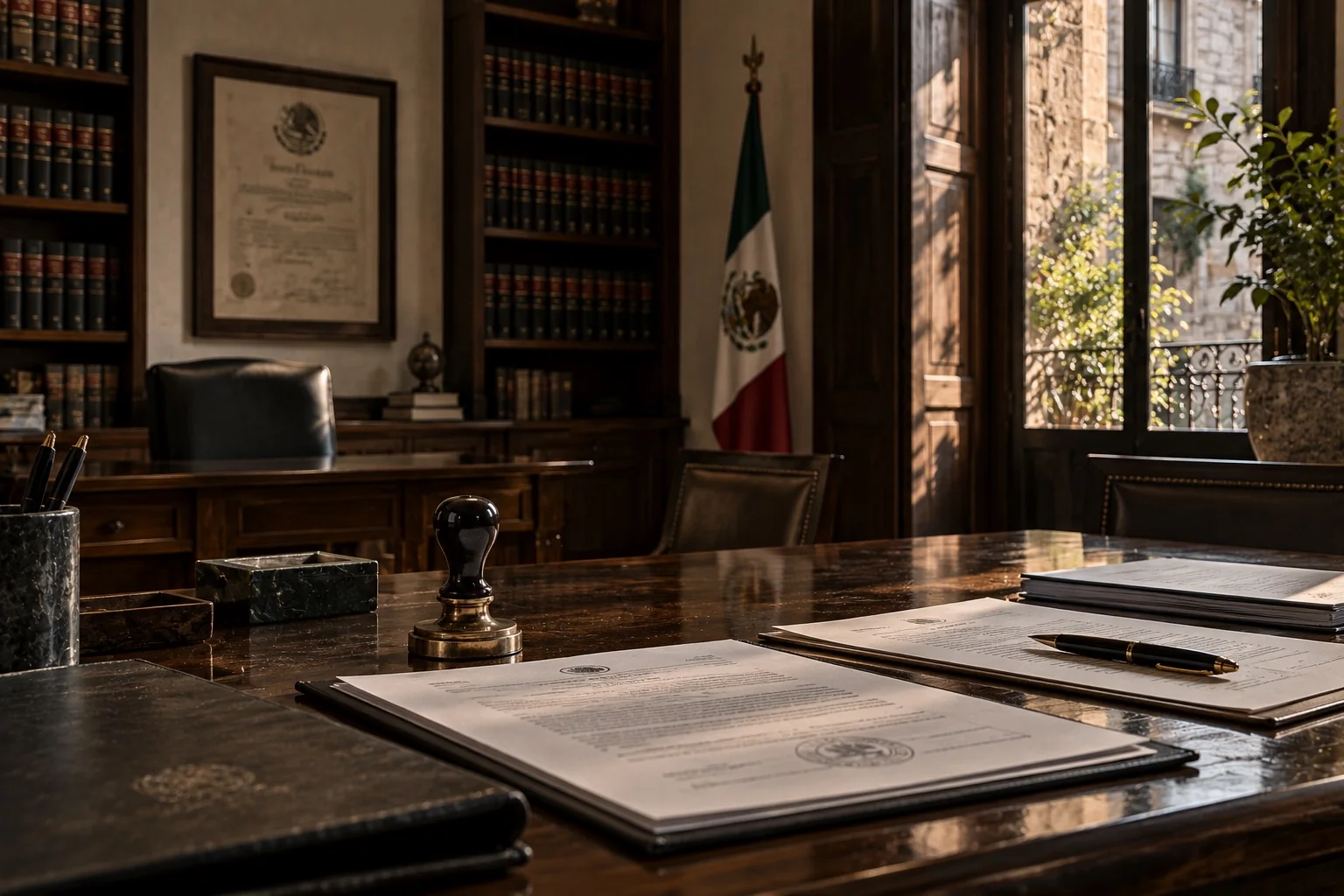
The notario drafts the deed, examines title at the Registry, confirms the identity and legal capacity of the parties, calculates and withholds the transfer taxes, and registers the final instrument. The work is exacting and generally done to a high standard.
It is also, deliberately, impartial. The notario acts for the validity of the transaction and for the state — not for the buyer and not for the seller. They will not advise whether the price is reasonable, will not negotiate terms, and as a rule will not review the promissory agreement before it is signed, since their involvement usually begins afterwards. The distinction commonly drawn in Mexican practice is that a notario identifies problems with a transaction rather than resolving them for one party.
A buyer treating the notario as their lawyer has an extremely well-qualified professional in the room who is not permitted to take their side.
Everyone at the table, and who pays them
What independent representation means
Closing the gap requires someone in the transaction whose only client is the buyer. In practice that means three things:
- No listing relationships and no seller-side commission. The advisor is paid by the buyer, and nothing about their compensation improves when the price rises or when one particular property is the one that completes.
- Legal and property work under a single engagement. Search, inspection, title examination, negotiation and closing coordinated by one team answerable to the buyer — rather than an agent and a lawyer who have never spoken to each other.
- Verification before commitment. Title chain, encumbrances, agrarian status, zoning and permits examined before the promissory agreement is signed, while withdrawing still costs nothing.
The third is where most of the money is won or lost, and it is a question of order rather than effort. The standard Mexican sequence performs the checks after the buyer has committed and paid, a problem we set out in detail in the due diligence sequence and when each check has to happen.
None of this is a criticism of Mexican practice. It is the standard buyers from the United States, Canada and Europe already expect at home, and it does exist in Mexico. But buyer-only representation is not the default here, and it is not something a buyer will come across without knowing the category exists and going looking for it. Nobody already in the transaction has a reason to mention it.
Not sure who is actually acting for you? Amanah works only for buyers — no listings, no seller-side commission, and a fee agreed before any work begins rather than taken as a share of the sale. Tell us where you are in the process and we will tell you plainly what we would do and whether you need us.
How Buyer Representation WorksFour things to ask for in writing
Questions invite answers, and answers are easy to give. These are worth framing as requests for something checkable instead.
- The engagement terms, showing where the fee comes from. Not “do you represent sellers” but the written agreement setting out who pays and whether any part of the fee originates on the seller's side. A firm working only for buyers can put that in a contract; an intermediary cannot.
- A written commitment that the legal review completes before you sign or pay anything. If review happens “at closing”, that is the market default and your leverage has already gone. A date in the engagement letter is worth more than a reassurance in a meeting.
- A sample of the report you will actually receive. Firms that produce written findings have examples with client details removed. Firms that do not, do not. This single request separates advisors from introductions faster than any question.
- Confirmation that every document will be explained in your language before signature. Every instrument in a Mexican transaction is in Spanish and binding in Spanish, and a summary afterwards is not the same as understanding beforehand.
Beyond the paperwork, apply the ordinary diligence you would apply to any professional engaged at this level: verify the qualification claimed, ask what comparable work they have completed and for whom, and speak to someone they have acted for.
The standard worth holding to
Most Mexican property transactions complete without incident. The distinction that matters is not between safe purchases and dangerous ones but between a purchase that merely completes and one that completes on terms the buyer had examined — and that usually turns on whether anyone in the room was working for them.
In the United States and Canada, few buyers go through a purchase without an agent of their own. Applying the same expectation here is neither suspicious nor elaborate — it is the ordinary level of care a transaction of this size warrants.
Which makes the first question not which property should I buy but a plainer one: who here is accountable to me, and how would I prove it?